


PFIC in adults

All images are actor portrayals.

While previously thought to be a pediatric condition, it is now clear that PFIC can have adult onset1-3

PFIC means progressive familial intrahepatic cholestasis3,4
- A group of rare genetic liver disorders3,4
- A result of genetic variants involving the formation or transport of bile3,4

Clinical presentation can be highly variable3
- May be episodic or insidious2,3,5,6
- May present later in life after a specific trigger3,5
PFIC is a chronic cholestatic liver disease7
In healthy enterohepatic circulation
- Bile acids are synthesized in liver cells, secreted in bile, and transported into the gallbladder before releasing into the small intestine7
- Most bile acids are reabsorbed from the terminal ileum via the ileal bile acid transporter (IBAT) and return to the liver via portal circulation7
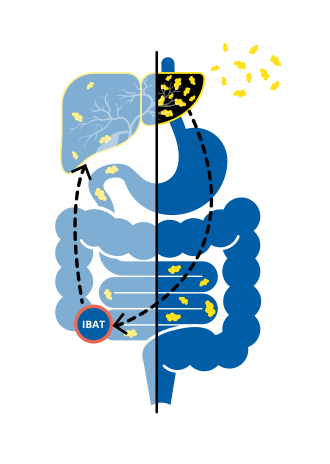
In cholestasis of PFIC
- Healthy enterohepatic circulation is disrupted by an impairment in bile flow from the liver to the intestines7,8
- This leads to the accumulation of bile acids in the liver, which may lead to liver damage7,8
- Excess bile acid “spills over” into the bloodstream, elevating serum bile acid (sBA) levels7,8
- Elevated sBA may play a role in pruritus9,10
Pruritus can be one of the most bothersome symptoms and may be caused by impaired bile flow.7,11

While PFIC commonly presents in the first months of life, it is now evident that variants in PFIC-associated genes ABCB4, ABCB11, and ATP8B1 can contribute to later onset forms of the disease.2

Could PFIC be hiding in your practice?
- A large cohort of 356 patients with adult-onset liver disease were screened for suspected genetic contribution2
- 28% had ≥1 potentially pathogenic variants in PFIC-causing genes ABCB4, ABCB11, or ATP8B1 2
Certain patient presentations of progressive cholestasis should be assessed for a PFIC diagnosis

Idiopathic or cryptogenic cholestasis
- Signs of cholestasis without apparent cause12,13
- Medical and familial history8

Cholestasis with pruritus or unusual presentation
- Small duct PSC13-16
- AMA negative PBC15,16
- MASLD* with pruritus17
- Lean MASLD* without metabolic syndrome17
- Lean MASH* with pruritus and without metabolic syndrome17

Secondary cholestasis triggered by liver issue
- All women with a history of ICP13,14
- Drug-induced cholestasis13,14
- Hormone-induced cholestasis triggered by birth control, menopause, anabolic steroids, augmentin/certain antibiotics, etc14,18,19

History of complicated gallstones
- Hepatolithiasis14,15
- Very strong family history of gallstones or incident at a young age13,14,20
- LPAC leading to stones in the gallbladder or liver13,21
PFIC is a rare disease, and symptoms overlap with other hepatic conditions, increasing the risk of misdiagnosis5
Diagnosing PFIC in Adults
Tests and procedures that may help establish a diagnosis include1,22:

- Biochemical tests (elevated sBA, elevated ALP, normal or elevated GGT, AMA and ANA levels)
- Additional imaging (ultrasound, MRCP, fibroscan)
- Supportive genetic analysis (ATP8B1, ABCB11, ABCB4, and other PFIC-associated genes)
An evaluation that uses a combined approach of clinical, imaging, and biochemical assessments is sufficient to support a PFIC diagnosis and initiate treatment.8,23
ALP=alkaline phosphatase; AMA=antimitochondrial antibody; ANA=antinuclear antibody; GGT=gamma-glutamyl transferase; IBAT=ileal bile acid transporter; ICP=intrahepatic cholestasis of pregnancy; LPAC=low phospholipid-associated cholelithiasis; MASH=metabolic dysfunction-associated steatohepatitis; MASLD=metabolic-dysfunction associated steatotic liver disease; MRCP=magnetic resonance cholangiopancreatography; NAFLD=nonalcoholic fatty liver disease; NASH=nonalcoholic steatohepatitis; PBC=primary biliary cholangitis; PFIC=progressive familial intrahepatic cholestasis; PSC=primary sclerosing cholangitis; sBA=serum bile acid.
*A multisociety Delphi consensus proposed a change to steatotic liver disease nomenclature, with metabolic dysfunction-associated steatotic liver disease (MASLD) chosen to replace NAFLD, and metabolic dysfunction-associated steatohepatitis (MASH) chosen to replace NASH.24
References:
- Dröge C, Götze T, Behrendt A, Gohlke H, Keitel V. Diagnostic workup of suspected hereditary cholestasis in adults: a case report. Explor Dig Dis. 2023;2:34-43. doi:10.37349/edd.2023.00016
- Nayagam JS, Foskett P, Stautnieks S, et al. Clinical phenotypes of adult-onset liver disease in patients with variants in ABCB4, ABCB11, and ATP8B1. Hepatol Commun. 2022;6(10):2654-2664. doi:10.1002/hep4.2051
- Vitale G, Sciveres M, Mandato C, Pio d’Adamo A, Di Giorgio A. Genotypes and different clinical variants between children and adults in progressive familial intrahepatic cholestasis: a state-of-the-art review. Orphanet J Rare Dis. 2025;20(1):80. doi:10.1186/s13023-025-03599-2
- Amirneni S, Haep N, Gad MA, Soto-Gutierrez A, Squires JE, Florentino RM. Molecular overview of progressive familial intrahepatic cholestasis. World J Gastroenterol. 2020;26(47):7470-7484. doi:10.3748/wjg.v26.i47.7470
- Berg T. Progressive familial intrahepatic cholestasis in adulthood: genetics, diagnosis, treatment, and further research. EMJ Hepatol. 2024;12[Suppl 2]:2-7. doi:10.33590/emjhepatol/HFCN9816
- Srivastava A. Progressive familial intrahepatic cholestasis. J Clin Exp Hepatol. 2014;4(1):25-36. doi:10.1016/j.jceh.2013.10.005
- Kamath BM, Stein P, Houwen RHJ, Verkade HJ. Potential of ileal bile acid transporter inhibition as a therapeutic target in Alagille syndrome and progressive familial intrahepatic cholestasis. Liver Int. 2020;40(8):1812-1822. doi:10.1111/liv.14553
- Gunaydin M, Bozkurter Cil AT. Progressive familial intrahepatic cholestasis: diagnosis, management, and treatment. Hepat Med. 2018;10:95-104. doi:10.2147/HMER.S137209
- Ibrahim SH, Kamath BM, Loomes KM, Karpen SJ. Cholestatic liver diseases of genetic etiology: advances and controversies. Hepatology. 2022;75(6):1627-1646. doi:10.1002/hep.32437
- Cholestasis. Cleveland Clinic. Updated December 19, 2022. Accessed December 4, 2025. https://my.clevelandclinic.org/health/diseases/24554-cholestasis
- Imam MH, Gossard AA, Sinakos E, Lindor KD. Pathogenesis and management of pruritus in cholestatic liver disease. J Gastroenterol Hepatol. 2012;27(7):1150-1158. doi:10.1111/j.1440-1746.2012.07109.x
- Aamann L, Ørntoft N, Vogel I, et al. Unexplained cholestasis in adults and adolescents: diagnostic benefit of genetic examination. Scand J Gastroenterol. 2018;53(3):305-311. doi:10.1080/00365521.2017.1422800
- Vitale G, Gitto S, Raimondi F, et al. Cryptogenic cholestasis in young and adults: ATP8B1, ABCB11, ABCB4, and TJP2 gene variants analysis by high-throughput sequencing. J Gastroenterol. 2018;53(8):945-958. doi:10.1007/s00535-017-1423-1
- Hsing AW, Bai Y, Andreotti G, et al. Family history of gallstones and the risk of biliary tract cancer and gallstones: a population-based study in Shanghai, China. Int J Cancer. 2007;121(4):832-838. doi:10.1002/ijc.22756
- Zen Y, Hübscher SG, Nakanuma Y. Bile duct diseases. In: Burt AD, Ferrell LD, Hübscher SG, eds. MacSween’s Pathology of the Liver. 7th ed. Elsevier; 2018:515-593.
- Chascsa DM, Lindor KD. Antimitochondrial antibody–negative primary biliary cholangitis: is it really the same disease? Clin Liver Dis. 2018;22(3):589-601. doi:10.1016/j.cld.2018.03.009
- Boehlig A, Gerhardt F, Petroff D, et al. Prevalence of pruritus and association with anxiety and depression in patients with nonalcoholic fatty liver disease. Biomedicines. 2022;10(2):1-10. doi:10.3390/biomedicines10020451
- Zu Y, Yang J, Zhang C, Liu D. The pathological mechanism of estrogen-induced cholestasis: current perspectives. Front Pharmacol. 2021;12:761255. doi:10.3389/fphar.2021.761255
- Petrovic A, Vukadin S, Sikora R, et al. Anabolic androgenic steroid-induced liver injury: an update. World J Gastroenterol. 2022;28(26):3071-3080. doi:10.3748/wjg.v28.i26.3071
- Sarin SK, Negi VS, Dewan R, Sasan S, Saraya A. High familial prevalence of gallstones in the first-degree relatives of gallstone patients. Hepatology. 1995;22(1):138-141.
- Goubault P, Brunel T, Rode A, Bancel B, Mohkam K, Mabrut J-Y. Low-phospholipid associated cholelithiasis (LPAC) syndrome: a synthetic review. J Visc Surg. 2019;156(4):319-328. doi:10.1016/j.jviscsurg.2019.02.006
- European Association for the Study of the Liver. EASL Clinical Practice Guidelines: management of cholestatic liver diseases. J Hepatol. 2009;51:237-267. doi:10.1016/j.jhep.2009.04.009
- McKiernan P, Bernabeu JQ, Girard M, et al. Opinion paper on the diagnosis and treatment of progressive familial intrahepatic cholestasis. JHEP Rep. 2023;6(1):100949. doi:10.1016/j.jhepr.2023.100949 Erratum in: JHEP Rep. 2024;6(6):101058. doi:10.1016/j.jhepr.2024.101058
- Rinella ME, Lazarus JV, Ratziu V, et al. A multisociety Delphi consensus statement on new fatty liver disease nomenclature. Hepatology. 2023;78(6):1966-1986. doi:10.1097/HEP.0000000000000520