


Rare autosomal-dominant disorder that affects multiple organ systems, including the liver2,3

One of the most common causes of inherited cholestasis in children4

Alagille syndrome is progressive in nature, and excess bile acids can damage hepatocytes1
Alagille syndrome can be diagnosed clinically or in combination with genetic testing. Early recognition and diagnosis are critical.5-9
Meeting 3 of 7 clinical criteria can establish a diagnosis5
Alagille syndrome impacts more than just the liver. Clinical diagnosis is based on involvement of at least 3 of the 7 main organ systems affected5:

hepatic

Cardiac

Facial

ocular

skeletal

renal

Vascular

A pathogenic variant in JAG1 or NOTCH2 can establish a diagnosis6
Molecular diagnosis can be established in patients with a heterozygous pathogenic or likely pathogenic finding in the JAG1 (94% of cases) or NOTCH2 (2%-4% of cases) genes through genetic testing.6,7
Early diagnosis of Alagille syndrome may improve patient management.8,9
Alagille syndrome is characterized by impaired enterohepatic circulation1
In healthy enterohepatic circulation1
- Bile acids are synthesized in liver cells, secreted in bile, and transported into the gallbladder before releasing into the small intestine1
- Most bile acids are reabsorbed from the terminal ileum via the ileal bile acid transporter (IBAT) and return to the liver via portal circulation1
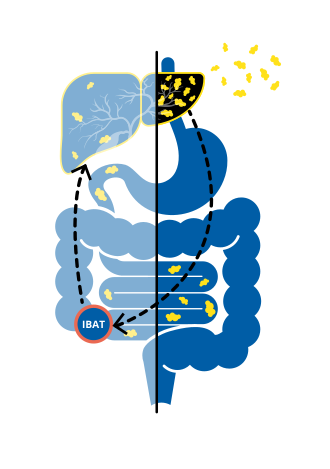
Alagille syndrome causes bile duct paucity, which results in cholestasis1,2
- Healthy enterohepatic circulation is disrupted by an impairment in bile flow from the liver to the intestines1,10
- This leads to the accumulation of bile acids in the liver, which may lead to liver damage1
- Excess bile acid “spills over” into the bloodstream, elevating serum bile acid (sBA) levels1
- Elevated sBA may play a role in pruritus11,12
Cholestatic pruritus can be one of the most bothersome symptoms and may be caused by impaired bile flow.1,13
ALGS=Alagille syndrome; IBAT=ileal bile acid transporter; sBA=serum bile acid.
References:
- Kamath BM, Stein P, Houwen RHJ, Verkade HJ. Potential of ileal bile acid transporter inhibition as a therapeutic target in Alagille syndrome and progressive familial intrahepatic cholestasis. Liver Int. 2020;40(8):1812-1822. doi:10.1111/liv.14553
- Kamath BM, Baker A, Houwen R, Todorova L, Kerkar N. Systematic review: the epidemiology, natural history, and burden of Alagille syndrome. J Pediatr Gastroenterol Nutr. 2018;67(2):148-156. doi:10.1097/MPG.0000000000001958
- Turnpenny PD, Ellard S. Alagille syndrome: pathogenesis, diagnosis, and management. Eur J Hum Genet. 2012;20(3):251-257. doi:10.1038/ejhg.2011.181
- Jeyaraj R, McKay Bounford K, Ruth N, et al. The genetics of inherited cholestatic disorders in neonates and infants: evolving challenges. Genes (Basel). 2021;12(11):1837. doi:10.3390/genes12111837
- Ayoub MD, Kamath BM. Alagille syndrome: diagnostic challenges and advances in management. Diagnostics. 2020;10(11):907. doi:10.3390/diagnostics10110907
- Spinner NB, Loomes KM, Krantz ID, Gilbert MA. Alagille syndrome. In: Adam MP, Feldman J, Mirzaa GM, et al, eds. GeneReviews® [Internet]. May 19, 2000. Updated January 4, 2024. University of Washington. Accessed August 2025. https://www.ncbi.nlm.nih.gov/books/NBK1273/
- Alagille syndrome. National Organization for Rare Disorders. Updated January 30, 2024. Accessed December 4, 2025. https://rarediseases.org/rare-diseases/alagille-syndrome/?filter=ovrds-resources
- Ebel NH, Goldstein A, Howard R, et al. Health care resource utilization by patients with Alagille syndrome. J Pediatr. 2023;253:144-151. doi:10.1016/j.jpeds.2022.09.033
- Ranucci G, Della Corte C, Alberti D, et al. Diagnostic approach to neonatal and infantile cholestasis: a position paper by the SIGENP liver disease working group. Dig Liver Dis. 2022;54(1):40-53. doi:10.1016/j.dld.2021.09.011
- Krantz ID, Piccoli DA, Spinner NB. Alagille syndrome. J Med Genet. 1997;34(2):152-157. doi:10.1136/jmg.34.2.152
- Ibrahim SH, Kamath BM, Loomes KM, Karpen SJ. Cholestatic liver diseases of genetic etiology: advances and controversies. Hepatology. 2022;75(6):1627-1646. doi:10.1002/hep.32437
- Cholestasis. Cleveland Clinic. Updated December 19, 2022. Accessed December 4, 2025. https://my.clevelandclinic.org/health/diseases/24554-cholestasis
- Imam MH, Gossard AA, Sinakos E, Lindor KD. Pathogenesis and management of pruritus in cholestatic liver disease. J Gastroenterol Hepatol. 2012;27(7):1150-1158. doi:10.1111/j.1440-1746.2012.07109.x
- BYLVAY. Prescribing Information. Ipsen Biopharmaceuticals, Inc.; 2025.