


Assert
Safety profile established in ASSERT1
Rates of serious adverse events (SAEs)1
| Participants with any | Placebo (n=17) n (%) |
BYLVAY 120 mcg/kg/day (N=35) n (%) |
|---|---|---|
| Treatment-emergent SAEs | 2 (12) | 5 (14) |
| Drug-related treatment-emergent SAEs | 0 | 1 (3) |

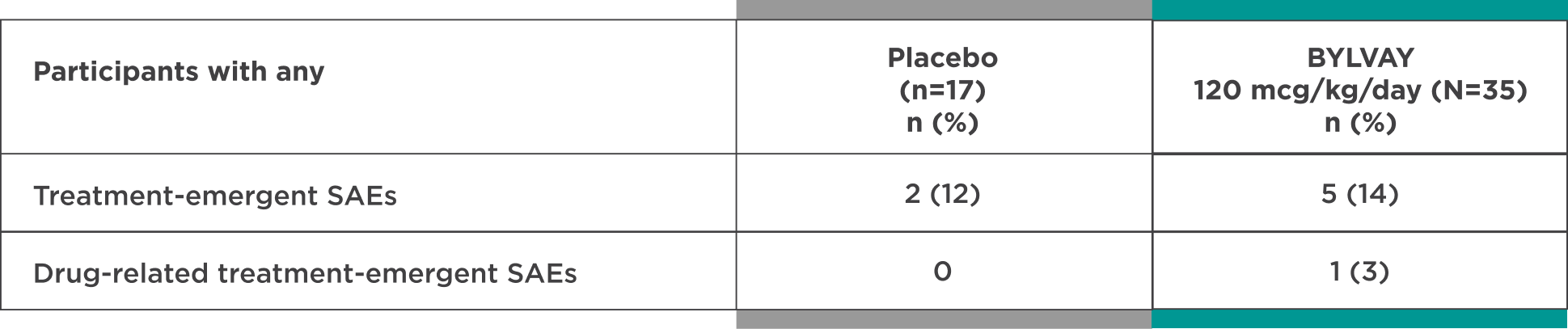
- Drug-related treatment-emergent SAEs in the BYLVAY group included hematemesis and increased INR1
- There were no discontinuations1
- No deaths were reported1
- Rates of fat-soluble vitamin deficiency were2:
- — 8.6% with BYLVAY 120 mcg/kg/day (n=35)
- — 17.6% with placebo (n=17)
Common adverse reactions (≥5%)3
| Adverse reaction | Placebo (n=17) n (%) |
BYLVAY 120 mcg/kg/day (n=35) n (%) |
|---|---|---|
| Diarrhea | 1 (6) | 10 (29) |
| Abdominal pain | 1 (6) | 5 (14) |
| Hematoma | 0 | 3 (9) |
| Weight decreased | 0 | 2 (6) |
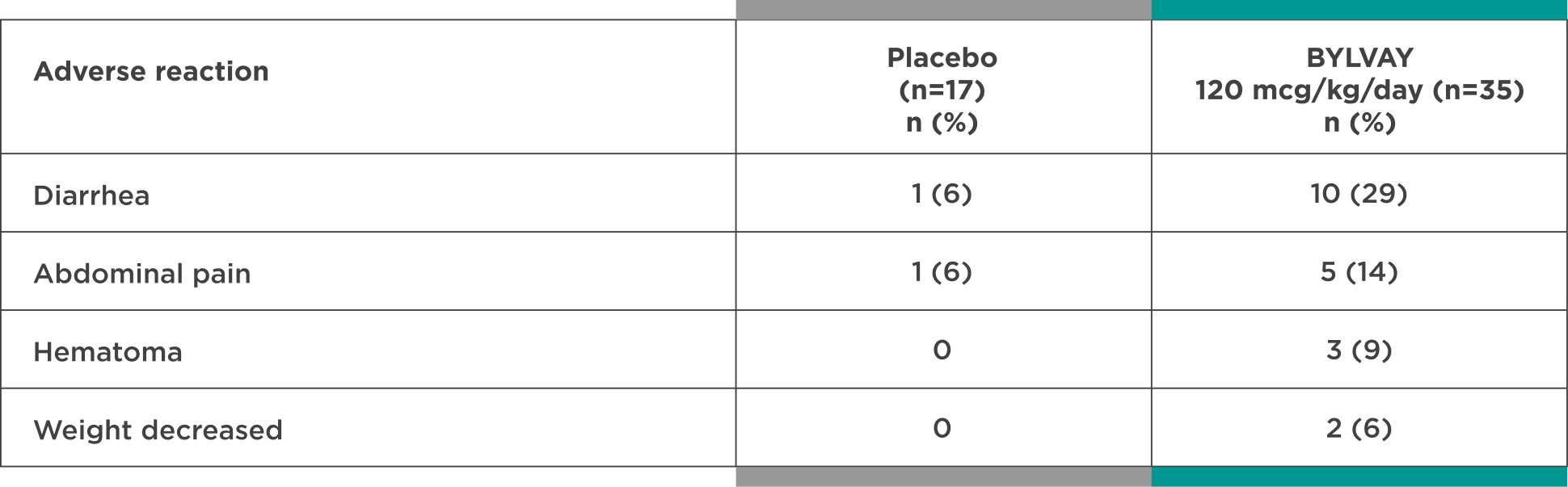
- Most treatment-emergent adverse events were mild to moderate in severity1
- All reports of diarrhea were grade 1 intensity (mild)1
- Treatment-related clinically significant diarrhea was reported in2:
- — 1 participant receiving BYLVAY (duration: 4 days)
- — 1 participant receiving placebo (duration: 24 days)
Assert-ext
Long-term safety profile established in ASSERT-EXT3,4
- Adverse reactions in 50 pediatric patients treated with BYLVAY 120 mcg/kg/day observed in ASSERT-EXT, in addition to those from the ASSERT trial described above in the common adverse reactions table, included the following reactions [n (%)]3,6:
|
Fat-soluble vitamin deficiency
|
Increased blood bilirubin: 2 (4) | Hematemesis: 1 (2) |
| Increased AST: 2 (4) | Hematochezia: 1 (2) | |
| Coagulopathy: 2 (4) | Epistaxis: 1 (2) | |
| ALT increased: 3 (6) | Fracture: 2 (4) | Constipation: 1 (2) |
| Headache: 3 (6) | Nausea: 1 (2) | |
| Increased INR: 3 (6) | Vomiting: 1 (2) |
|
Fat-soluble vitamin deficiency
|
| ALT increased: 3 (6) |
| Headache: 3 (6) |
| Increased INR: 3 (6) |
| Increased blood bilirubin: 2 (4) |
| Increased AST: 2 (4) |
| Coagulopathy: 2 (4) |
| Fracture: 2 (4) |
| Nausea: 1 (2) |
| Vomiting: 1 (2) |
| Hematemesis: 1 (2) |
| Hematochezia: 1 (2) |
| Epistaxis: 1 (2) |
| Constipation: 1 (2) |
- The most common reason for BYLVAY treatment discontinuation was increased bilirubin levels
- One patient underwent liver transplant in ASSERT-EXT prior to Week 72. No patients underwent surgical biliary diversion during the study
ASSERT-EXT is an open-label extension of the ASSERT trial.5
ALT=alanine aminotransferase; AST=aspartate aminotransferase; INR=international normalized ratio; SAE=serious adverse event.
References:
- Ovchinsky N, Aumar M, Baker A, et al. Efficacy and safety of odevixibat in patients with Alagille syndrome (ASSERT): a phase 3, double-blind, randomised, placebo-controlled trial. Lancet Gastroenterol Hepatol. 2024:9(7):632-645. doi:10.1016/S2468-1253(24)00074-8
- Data on file. Ipsen US. [NON-US-004420].
- BYLVAY. Prescribing Information. Ipsen Biopharmaceuticals, Inc.; 2025.
- Data on file. Ipsen US. [NON-US-004440].
- ClinicalTrials.gov. Long-term safety and efficacy of odevixibat in patients with Alagille syndrome. NCT05035030. Updated March 2, 2026. Accessed March 12, 2026. https://clinicaltrials.gov/study/NCT05035030
- Data on file. Ipsen US. [NON-US-004670].