


PEDFIC 1
Safety profile established in PEDFIC 11
Serious TEAEs1
| Placebo (n=20) n (%) |
BYLVAY 40 mcg/kg/day (n=23) n (%) |
BYLVAY 120 mcg/kg/day (n=19) n (%) |
|---|---|---|
| 5 (25) | 0 | 3 (16) |


- All SAEs were unrelated to treatment, and none led to discontinuation2
- — Treatment-emergent SAEs in the BYLVAY 120 mcg/kg/day group included supraventricular tachycardia, urinary tract infection, dehydration, and elevated liver function tests
- No deaths were reported1
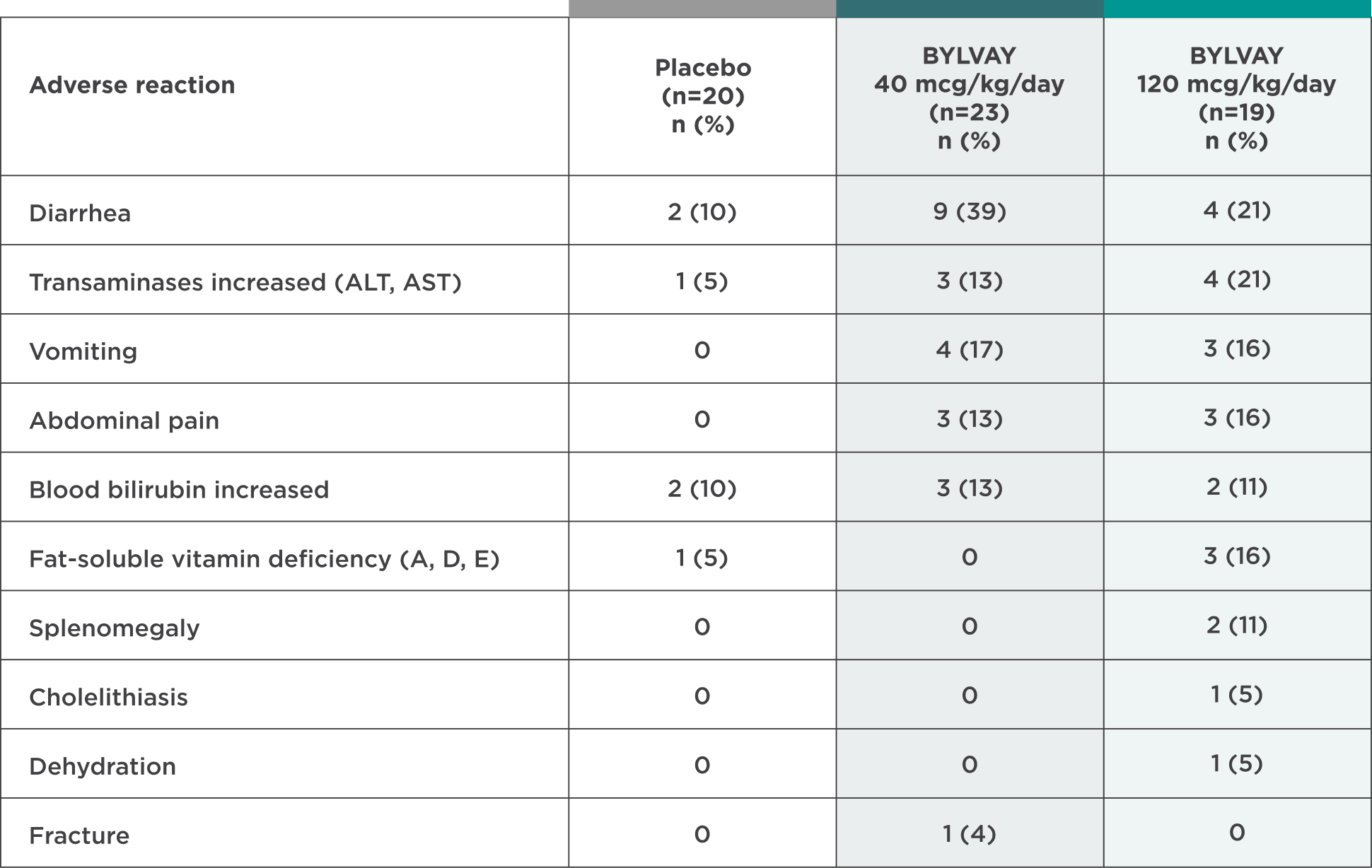
Common adverse reactions (≥2%)3
| Adverse reaction | Placebo (n=20) n (%) |
BYLVAY 40 mcg/kg/day (n=23) n (%) |
BYLVAY 120 mcg/kg/day (n=19) n (%) |
|---|---|---|---|
| Diarrhea | 2 (10) | 9 (39) | 4 (21) |
| Transaminases increased (ALT, AST) | 1 (5) | 3 (13) | 4 (21) |
| Vomiting | 0 | 4 (17) | 3 (16) |
| Abdominal pain | 0 | 3 (13) | 3 (16) |
| Blood bilirubin increased | 2 (10) | 3 (13) | 2 (11) |
| Fat-soluble vitamin deficiency (A, D, E) | 1 (5) | 0 | 3 (16) |
| Splenomegaly | 0 | 0 | 2 (11) |
| Cholelithiasis | 0 | 0 | 1 (5) |
| Dehydration | 0 | 0 | 1 (5) |
| Fracture | 0 | 1 (4) | 0 |
- Most TEAEs were mild to moderate in severity1
- Most common adverse reactions (>2%) were liver test abnormalities, diarrhea, abdominal pain, vomiting, and fat-soluble vitamin deficiency3
- 3 participants in the BYLVAY 120 mcg/kg/day group discontinued, with 1 due to TEAEs1
PEDFIC 2
Long-term safety profile established in PEDFIC 23-5
- Adverse reactions observed in 116 patients with PFIC types 1, 2, 3, 4, and 6, treated with BYLVAY 40 mcg/kg/day or 120 mcg/kg/day in PEDFIC 2, were similar to those from the PEDFIC 1 trial described above in the clinical adverse reactions table3
- Fractures were reported in a total of 6 patients (5%)3
- In addition, BYLVAY-treated patients in PEDFIC 2 experienced the following adverse reactions [n (%)3,6]:
| Increased INR: 19 (16) | Nausea: 3 (3) | Variceal hemorrhage: 1 (<1) |
| Epistaxis: 10 (9) | Rash: 3 (3) | Stoma hemorrhage: 1 (<1) |
| Constipation: 9 (8) | Iron deficiency anemia: 3 (3) | Hematochezia: 1 (<1) |
| Coagulopathy: 3 (3) | Gastroesophageal reflux disease: 2 (2) | Rectal hemorrhage: 1 (<1) |
| Headache: 3 (3) | Prolonged prothrombin time: 2 (2) |
| Increased INR: 19 (16) |
| Epistaxis: 10 (9) |
| Constipation: 9 (8) |
| Coagulopathy: 3 (3) |
| Headache: 3 (3) |
| Nausea: 3 (3) |
| Rash: 3 (3) |
| Iron deficiency anemia: 3 (3) |
| Gastroesophageal reflux disease: 2 (2) |
| Prolonged prothrombin time: 2 (2) |
| Variceal hemorrhage: 1 (<1) |
| Stoma hemorrhage: 1 (<1) |
| Hematochezia: 1 (<1) |
| Rectal hemorrhage: 1 (<1) |
- Adverse reactions leading to treatment discontinuation were increased bilirubin levels, diarrhea, progression of disease, increased INR, irritability, and decreased weight3
- A total of 19 (16%) patients underwent surgical intervention, 11 of whom had these surgical interventions prior to Week 723:
| 1 patient had surgical biliary diversion (SBD) followed by liver transplant |
| 15 patients underwent liver transplant alone |
| 3 patients underwent SBD alone |
PEDFIC 2 is an open-label extension of the PEDFIC 1 trial.5
BYLVAY offers once-daily dosing and flexible administration3
All images are actor portrayals.
ALT=alanine aminotransferase; AST=aspartate aminotransferase; INR=international normalized ratio; SAE=serious adverse event; SBD=surgical biliary diversion; TEAE=treatment-emergent adverse event.
References:
- Thompson RJ, Amell H, Artan R, et al. Odevixibat treatment in progressive familial intrahepatic cholestasis: a randomised, placebo-controlled, phase 3 trial. Lancet Gastroenterol Hepatol. 2022;7(9):830-842. doi:10.1016/S2468-1253(22)00093-0
- Data on file. Ipsen US. [NON-US-004422].
- BYLVAY. Prescribing Information. Ipsen Biopharmaceuticals, Inc.; 2025.
- Data on file. Ipsen US. [NON-US-004423].
- Thompson RJ, Artan R, Baumann U, et al. Interim results from an ongoing, open-label, single-arm trial of odevixibat in progressive familial intrahepatic cholestasis. JHEP Rep. 2023;5(8):100782. doi:10.1016/j.jhepr.2023.100782
- Data on file. Ipsen US. [NON-US-004671].